
The Morningside Stones Project


Morningside Masons and Medieval Stones: Researching a lost ‘local tradition’
A project funded from a Jean Guild Grant by the Old Edinburgh Club.
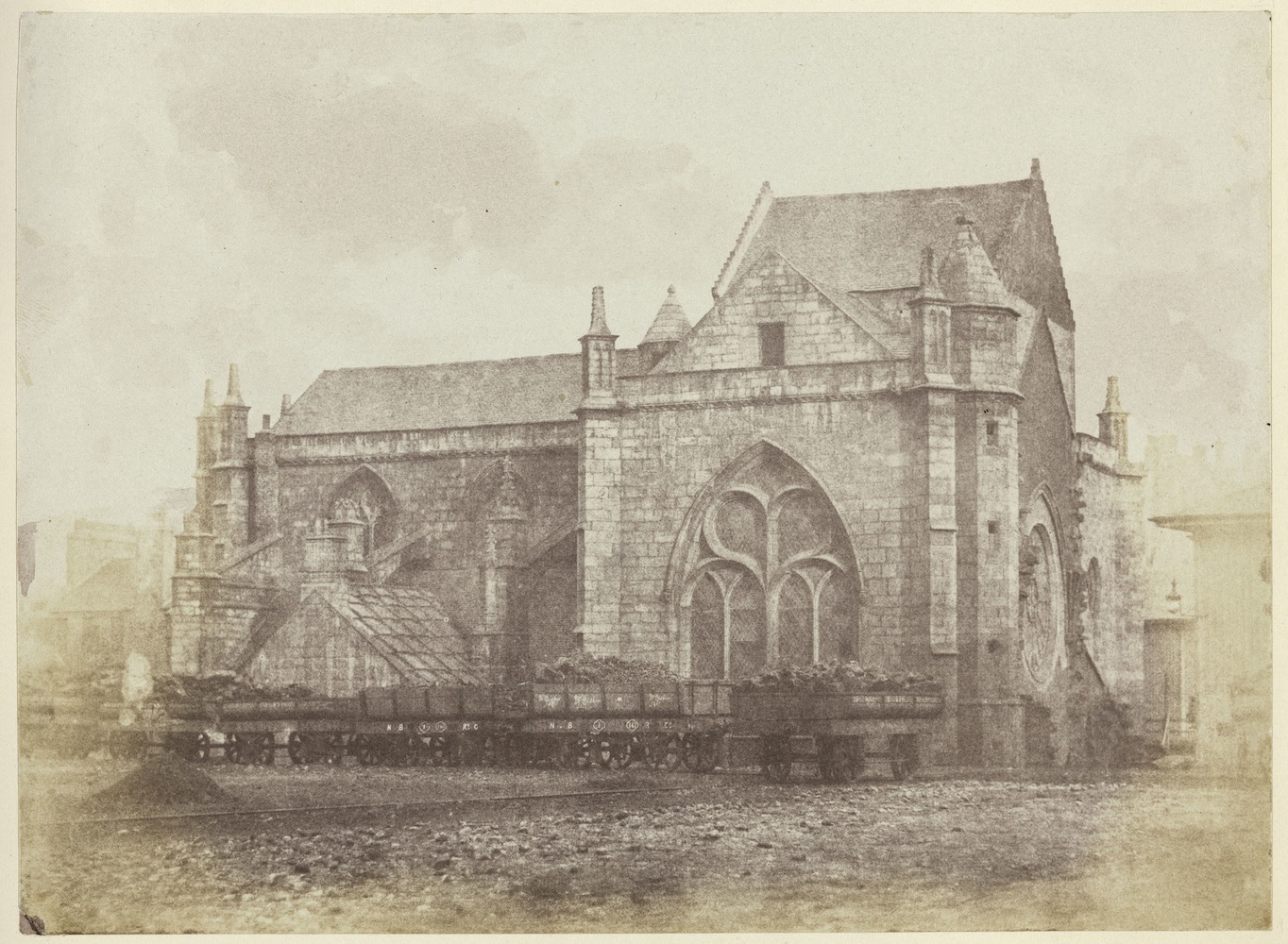
Trinity Collegiate Church, awaiting demolition in 1848 to make way for Waverley Station.
Image by Ross and Thomson Photographers circa 1847; source Royal Collection Trust.
The Background
Writing in Historic South Edinburgh (2000, p145), Charles Smith made reference to ‘a number of interesting and apparently very old ecclesiastical stones of varied motifs. Local tradition has it that these stones were set here by the owner of the nearby sculptor’s yard.’ Could they have been from the 15th century Trinity Collegiate Church, demolished in 1848 for the construction of Waverley Station?
Objectives
- To learn more about nineteenth century Morningside stonemasons.
- To explore connections between them and the presence of the stones in a local Morningside wall.
- To protect the stones in their current location, and encourage local interest in their history and their wider heritage significance.
- To contribute to the OEC’s purpose of exploring the history and development of Edinburgh.
Meeting our Objectives
- From the initial focus of the project, based predominantly on Post Office Directories and Morningside Census records, a dataset of over 50 sculptors, stonemasons, builders and wrights have been identified between 1850 and to 1925.
- Ongoing research is being undertaken from a wider range of sources including Scotland’s People, Dean of Guild Records, Historic Environment Scotland Archives, Capital Collections, the National Library of Scotland, the Central Library Edinburgh Room, and the University of Edinburgh Library.
- Opportunities to learn more about the project include plans for a showcase evening, an exhibition, small group visits to view the stones, stonemasonry workshops and the development of an interactive website.
- Information on the project is also available on the News & Views page of The Old Edinburgh Club – exploring the city through history – The Old Edinburgh Club.
- Further outputs are the development of an interactive website and an on-site interpretation panel.
Viewing the Stones
If you would like to visit the stones and learn more about them or are interested in joining the search for the sculptor email us using the following address:
The Old Edinburgh Club is registered as Scottish Charity SC006177.
The Morningside Heritage Association is registered as Scottish Charity SC044409.
19th-century Morningside Masons and Medieval Stones
Update : April 2026
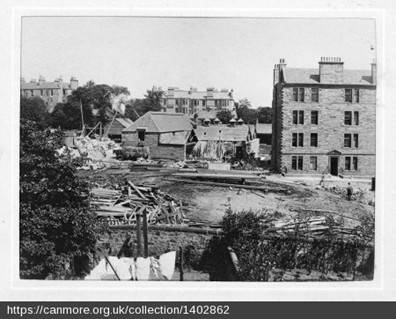
View E. from 38 Morningside Park, Edinburgh.
Remains of Reid’s cow park and byres : tenements well advanced. Summer 1899
William Edgar Evans
In 1898 and 1899 the young photographer, William Edgar Evans, took two images of John Reid’s extensive dairy farm from an upstairs window of his home at 38 Morningside Park Road.
The caption to the first image, taken on 28 January 1898, suggests the early stages of construction of the tenements that now form Morningside’s Springvalley Gardens and Terrace – the area on which this project is focussed.
This 1899 depiction of the horse and its loaded cart offer a poignant evocation of the transition from James Grant’s “rural solitude” of the “secluded village consisting of little more than a row of thatched cottages, a line of trees and a blacksmith’s forge”, as the pace of change took hold over the last years of the 19th century.
The foundations of this project have been laid predominantly from Gray’s Annual Directories for Edinburgh of 1836-7, Post Office Directories from 1832 to 1901-02, and the Morningside Census enumerations from 1841 (the first Census of Morningside) to 1911. Individual records identified include five wrights, eight builders, two sculptors and 31 masons (including a mason bankhead and a mason freestone).
The records include James, Simon, Robert, John and Peter, the five sons of John Slater, a successful Shetland builder, and his wife Janet Paton Slater. From the discovery of two images in the Historic Environment Scotland (HES) Archives, and of a specific set of Morningside title deeds, it is James and Simon who are the primary focus of my ongoing research.
Slater family and James Slater
The two images from HES Archives, referred to above, relate to the Slater family, and specifically to James. Taken in Lerwick circa 1872, the first is a formal photograph of a prosperous family. With their parents are four of their five sons and all five daughters ; all are well dressed – the boys in three-piece wool suits, the girls in smart and seemingly fashionable dresses. The photograph may have been taken to send to James, the eldest son (born circa 1849), who had moved to work in Edinburgh by the time of the 1869-70 Post Office Directory, and became a successful builder.
The second image, of a group of more than 40 builders and contractors in James Slater’s yard at 172 Easter Road in 1894, reflects James’ success as a builder. The reconstruction in 1885 of the Mercat Cross, on the High Street is one of many examples of his achievements, as is his inclusion, noted by Richard Rodger, in the list of the Principal Builders in east Edinburgh between 1881 and 1905. This success is likely reflect his father’s influence as much as being in the right place at a time of what Richard Rodger has described as “intense building activity” in east Edinburgh between 1883 and 1893.
His activities were not, however, confined to east Edinburgh. From The Buildings of Scotland, it becomes clear that, although he is enumerated in the Morningside Census only in 1891, James has a number of projects in the Morningside area from circa 1880. Initially working with the architects Robert Rowand Anderson and George Washington Browne, on a “picturesque Queen Anne development”, (now known as the Red House, 1 Cluny Gardens), by 1886 he is building at 33 Cluny Gardens “and presumably its neighbours”. In 1888, he is working with Huw Wardrop and Robert Rowand Anderson, on the “quite ordinary double villas” of Braid Avenue ; and finally, in 1898, with the architects Dunn and Findlay on the development of the Plewlands estate at the top of Morningside Drive (their Drawing no, 2 is inscribed on the back ‘Villas at Plewlands- No 1 James Slater’. It is unlikely, however, that he lived at that address, for some time between 1898 and 1901 he had moved to London, where the 1901 Census of England and Wales records him living in Brixton, with his family, and working as a Clerk of Building Works.
James died in Brixton on 10 July 1902. On 11 July, the Scotsman reported that his funeral “would be from Waverley Station on the following day (Saturday 12 July) “at 3.30 p.m., to Warriston Cemetery”.
The father’s influence as a builder seems also to have extended to James’ four brothers. The 1881 Census Edinburgh Greenside and South Leith records Simon, John and Peter, with their sister Robina at 30 Maryfield Place. Robina gives her occupation then as ‘housekeeper’ – perhaps she was keeping house for her brothers. Simon, and Peter (who died in Edinburgh on 15 May 1889, aged 29), both enumerated as masons – Simon as a foreman – may be working with James.
By 1891, both Simon and James were living in Morningside, James at 18 Braidburn Terrace and Simon at 12 Braid Road. The 1901 Census records John living at 57 Newington Road ; he remained at that address until his death in 1936. The 1911 Census records his occupation as roofing contractor and asphalter ; he and Robert are joint petitioners in 1903 to undertake work on the smithy at 10 Springvalley Gardens. Although initially a joiner, living in the Greenside area of Edinburgh, Robert is recorded as a builder and employer in 1901, and as a mason and joiner (employer) in 1911, by which time he had moved to 80 Morningside Road.
Simon Slater
Although my focus on Simon is especially with his connection to the Springvalley area of Morningside, he had interests elsewhere in Edinburgh that would also suggest his achievements as a builder. In particular, the Dictionary of Scottish Architects records that, in 1896, he had commissioned the architect Peter Robert McLaren to design a four-storey tenement, with shops, on the corner of Smithfield Street and Gorgie Road ; this building now has a Grade Two listing by Historic Environment Scotland – the Statement of Special Interest including the comment “Built for Simon Slater who developed much of the surrounding area.” There is also correspondence with Norah Geddes, daughter of Patrick Geddes and wife of Frank Mears, cited in the University of Strathclyde Archives and Special Collections, relating to “estimates for additions to railings at Castlehill”.
The Morningside title deeds referred to earlier, record that, on 17 May 1897, John Reid transferred legal ownership of 1,800 acres of his dairy farm to Simon. Dean of Guild records show that, by September of that year, Simon had been granted a warrant to develop two tenements in Springvalley Gardens, with a further five warrants granted for the Gardens between April and October 1898. Two petitions lodged in July and August 1899 were for eight four-storey tenements, on the east side of Springvalley Terrace, and five tenements (of unspecified storeys) on its west side .
1901 is the year in which Simon and Robert are first recorded as joint petitioners, although of the five petitions lodged only two related to Springvalley (the remaining three are for crane staging in other parts of the city). In September of 1902, they applied jointly for a warrant to convert workshops at 14 Springvalley Gardens – the site of what is now known as the Wild West Yard.
That Simon was in growing demand as a builder from these last years of the 19th century, and additionally that he and Robert were the builders commissioned by the architects James Bow Dunn and James Leslie Findlay for the Wesleyan Mission Hall (now known as Central Hall) constructed between 1899 and 1901, may suggest a reason for two decisions relating to the ongoing development of the Springvalley estate. First, in June 1899, Dean of Guild records list James White as the petitioner for the development of a two-storey building on the north side of Springvalley Gardens. And second, on 19 May 1902, Simon leases 4 and 6 Springvalley Terrace to a Peter Mackenzie ; it would seem from the ‘burdens’ set out for this transaction – that construction much be in accordance Simon’s plans – that the two tenements were at best only partially built.
Looking Ahead
The possibility of confirming how the stones came to be in their current position has gained impetus from these findings, but some individual records, most notably those for James McDonald or Macdonald, who had yards both at Maxwell Street and at Leamington Road and Fountainbridge, have proved elusive. Might James White, recorded in the 1891 Census of Morningside as a mason and living in Balcarres Street – have worked in the Maxwell Street yard of our elusive James McDonald or Macdonald, and with Simon and Robert? Were the Bankerhand Mason, and the Freestone Mason, also working with Simon and Robert? Might some of the 40 or more workers in the 1894 photograph of James Slater’s construction yard also have worked with him, and later with Simon?
Citations
Bankerhead, or Banker Masons are stonemasonry professionals who specialise in the manual preparation of stone blocks. They use blueprints that clients or designers provide to carve rocks into specific shapes or sizes. Banker masons vs fixer masons: the key differences (Indeed.com UK)
Mason Freestone : the Elite Craftsmen : Freestone masons held a prestigious position in the hierarchy of stonemasonry. These craftsmen specialized in working with freestone, a type of sandstone or limestone, ideal for intricate carvings due to its soft and uniform texture. Freestone Mason – The Square Magazine
James Grant, ‘Old and New Edinburgh’ (London, 1882) Vol. III p. 38
Grays Annual Directories of Edinburgh : 1832-1838 – Gray’s annual directory – Towns > Edinburgh – Scottish Directories – National Library of Scotland
Scottish Post Office Directories 1846-1975 – Post Office Edinburgh and Leith directory – Towns > Edinburgh – Scottish Directories – National Library of Scotland
Scottish Census Records 1841-1911: Census Records – National Records of Scotland (NRS)
Historic Environment Scotland : The Slater family in Lerwick, Shetland, around 1872. Collection : Records of the Scottish Cultural Resources Access Network (SCRAN) Ref: DP484870 ; External reference(s) : 000-ooo-463-562, 000-000-463-562-R
Historic Environment Scotland : Group of builders and contractors, Easter Road, Edinburgh, 1894. Collection : Records of the Scottish Cultural Resources Access Network (SCRAN). Reference : DP 486926 ; External Reference(s) : 000-000-465-618-c, 000-000-465-618-R
Edinburgh City Archives (ECA) : George Heriot’s Hospital Role of Superiorities, 1913-14, ff. 35-82, and ECA City of Edinburgh Superiorities 1814 ; in Richard Rodger, ‘The Transformation of Edinburgh: Land, Property and Trust in the Nineteenth Century’ (Cambridge University Press, 2001; pbk 2004), pp. 107-108
John Gifford, Colin McWilliam and David Walker, ‘Edinburgh’, in Colin McWilliam (ed.) ‘The Buildings of Scotland’ (Penguin Books, 1984 reprinted 1988 with revisions) p.623
National Records of Scotland (NRS) : Wills and Testaments Reference SC70/1/416, Edinburgh Sheriff Court Inventories, Image 939 Last Image 943
ScotLIS : Title Information MID131455 : Section D – Burdens 1 Land Registry Search | Online Land Registry
Dictionary of Scottish Architects (1660-1980) Dictionary of Scottish Architects – Search
Piece 23 – Letter from S & R Slater (Builders), Edinburgh to Norah Geddes (17 July 1913) Archives & Special Collections | University of Strathclyde
ScotLIS : Title Information MID131455 : Section D – Burdens 2 Land Registry Search | Online Land Registry A feu charter was a formal legal document used in Scots law to establish a specific historical form of land ownership known as ‘feu tenure’ for an indefinite period (Source : LSDefine). The Burdens were certain conditions or obligations on Peter Mackenzie, and he would likely have paid an annual amount (‘feu duty) to Simon. The Abolition Feudal Tenure (Scotland) Act 2000 largely brought this form of land ownership to an end.
Edinburgh City Archives : Edinburgh Dean of Guild Court Records SL144/1 : 59 : 1896 Mar 5 – 1899 May 25
Scotsman newspaper 11 July 1902, p. 10 ; record provided by Shetland Family History Association